I Expressed My Large Dogs Anal Glands 2 Weeks Ago and Theyre Full Again
Our mission is to help relieve dogs' and cats' lives through our educational content. To support our efforts, this page may contain chapter links. We earn a commission for qualifying purchases – at no cost to y'all.

Oh, what a pain in the barrel those anal glands tin be!
Information technology only seems to exist a fact that most dogs have, at one fourth dimension or another, bug with their anal glands.
There are times that the anal glands tin become so impacted that they develop an infection resulting in an abscess or cellulitis (inflammation in the surrounding tissue).
This state of affairs is not only painful for the poor dog'south barrel, simply it also causes a nasty mess and can be lamentable for you.
And so, this leads ane to ask, "Why in the globe do dogs accept these two little annoyances at their back end, and what tin can I do to help prevent my dog from suffering from regular anal gland problems?" Let'due south go to the bottom of information technology!
How Do Anal Glands Get Infected?
So how and why does this whole mess get started? The most common reason anal glands become a problem is when they become impacted (the foul-smelling liquid isn't able to be expressed when the dog poops), causing the secretions to build up and become infected. This impaction is uncomfortable, and the longer the secretions stay in the gland and beginning to thicken, the more painful it becomes, and a greater chance of rupture exists. One time this procedure has started, then the issues begin.
The following take a chance factors tin alter the beefcake associated with the glands, or affect your dog's poop (i.e., the consistency of the poop). And it's these factors that can predispose a dog to having more problems with their anal glands becoming infected.
Weather that tin can increase chances of anal gland problems include:
- Being overweight or obese
- Diarrhea (caused past illness, sudden nutrient changes, inappropriate treats or food)
- Food hypersensitivities (food allergies)
- Atopic dermatitis (ecology allergies)
- Chronic (deep) skin infections with bacteria and/or yeast
- Abnormal anal tone – inability to contract the anal sphincter normally
- Obstacle of the anal gland duct – mass/tumor, inflammation to the muscles, etc.
- Skin mite infestations (e.thou., Demodex, Sarcoptes)
The divergence in anal glands betwixt species
While both dogs and cats have anal glands and both species can develop infections, it is much more common for dogs than cats to get infections. This is probable a very good situation for us veterinarians considering cats Really hate to have their anal glands expressed. With that being said, fifty-fifty though information technology is my life'south goal for all pet owners to know how to limited anal glands, I would propose that ane does not attempt to express their cat's anal glands at home but rather accept them to a veterinarian.
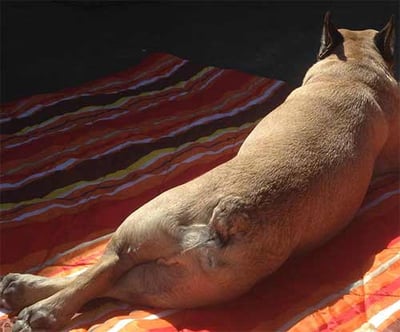
How is breed a gene?
Equally with species, in that location also seems to exist a correlation to breed. In my experience, minor breed dogs, such equally Poodles and Chihuahuas, seem to stand for a college proportion of dogs with anal gland bug versus larger breed dogs. At that place are maybe several reasons for this.
In my experience, smaller brood dogs tend to be given more table foods, which can crusade their poop to exist softer and therefore not cause adequate muscle wrinkle to express the glands. Also, smaller breed dogs are by and large more than nervous and anxious than larger breeds – the well-known "Chihuahua shake and shiver." Typically, this alters the stool'due south firmness, and therefore the glands are not expressed as they need to be.
Smaller breeds too tend to be less active, so the muscles in the rump are not as stiff every bit in larger breeds. Weight distribution on smaller breeds is different than with larger breeds. Even a piddling bit of extra weight can impact the expression of the glands (a Chihuahua that is i pound overweight is like a human gaining 33 pounds, whereas a beagle gaining 5 pounds but equates to a human gaining 20 pounds).
Another last possibility is many small brood dogs have hind limb conformational bug. These can cause issues with their knees, such as luxating patellas (the kneecap moves in ways information technology shouldn't!), that prevent them from squatting properly and holding a squat. This has an touch on on the contraction of the muscle effectually the glands causing poor expression of them.
How is age a factor?
Older pets seem to accept issues more than frequently than younger animals. The theory here is that they are unable to squat long plenty and exert the same pressure pooping then that the fecal matter tin can push against the glands to express them naturally. The reason could too be a previous injury, arthritis, age-related wellness bug, etc. But to be articulate, still, not all older pets have anal gland problems, but I recommend that if you have an older pet and they accept some of the symptoms that are mentioned later in this article, you monitor them for anal gland bug.
How could grooming be a risk factor?
In my practice, I frequently saw more dogs with anal gland infections that were regularly clean-cut past a groomer – a groomer not associated with a veterinary practice. Why you may enquire? The reason is that groomers can Merely (usually by law) express anal glands externally – the difference between external and internal expression is explained later in the commodity. And the reason that this is an event is that they cannot fully empty the gland completely, and therefore they leave secretions behind; plus, they have also created inflammation, which narrows the already small duct that empties the gland.
The secretions are at present deeper in the gland, and there is inflammation by squeezing the gland and surrounding muscles in an unnatural mode (causing swelling), and then the secretions begin to thicken, and the infection starts to develop.
While no i wants their freshly groomed and pampered pet to smell similar anal gland secretions, I highly propose request your groomer non to express your pet'due south anal glands. I have establish it best to bring your pet just before or just after grooming to a veterinary clinic to have the glands expressed internally by a trained veterinary staff fellow member.
How to Tell When Your Dog Has a Problem With Their Anal Glands
The fortunate affair in most cases is that your pet will requite you plenty of signs that there may be a problem. Some of these signs are more than obvious than others, withal. The good matter is that you know your dog improve than anyone else, and y'all are probable to notice when things seem a trivial off. If you run across whatsoever of these signs repeatedly or know your canis familiaris has had a history of anal gland bug, it is likely a good thought to visit your veterinary clinic. The sooner the result is evaluated by a veterinarian, the sooner your pet tin become more comfortable, and the happier you volition be.
Is your dog scooting?
The most obvious sign that one sees is their pet dragging their butt on the ground (veterinarians refer to information technology as scooting, likely because it sounds cuter!). The reason dogs practise this is to assist express the glands but besides because the secretions do make them itchy. Another signs may exist:
- Excessive licking at the rectum
- Reluctance to sit
- Chewing at the base of the tail or on the hip
- Foul olfactory property may be noticed
- Blood on their poop
- Straining, vocalizing, or otherwise having difficulty or pain when pooping
- Swelling or bulging nether the pare around the rectum
- Blood or pus on the carpet, their bed, or any other area they have been resting
- In rare cases, I take seen difficulty walking
- NOTE: If you happen to be brave and express your domestic dog's glands (I recommend you use a white newspaper towel or large gauze pad), and if you observe the secretions are night brown and there are any flecks/chunks or thickness, there is an infection. Bring your pet and the toweling with the secretions to the vet! Besides, if your groomer expresses the glands, be sure to ask what the secretions looked like.
How to Prevent or Lessen Anal Gland Issues
Have your domestic dog seen by your veterinarian
The sooner you get your pet seen by a veterinarian, the sooner they can get relief and, in all honesty, information technology'll probable be cheaper, in the long run, to take it treated sooner rather than afterward! Your veterinary will do a full physical examination – this helps determine if in that location is another upshot increasing the chances of anal gland bug. They'll acquit a visual and digital rectal exam (yup, poor pup gets a finger in their butt!).
I want to let you know that your canis familiaris may yelp or resist because, as mentioned before, the surface area is swollen and tender. Only it's critical that your veterinarian does a complete exam, and the best way to check the beefcake every bit well equally to express the glands is to gently "milk" them out from the inside (I oft described it to my clients that it is like gently squeezing out a grape from its peel).
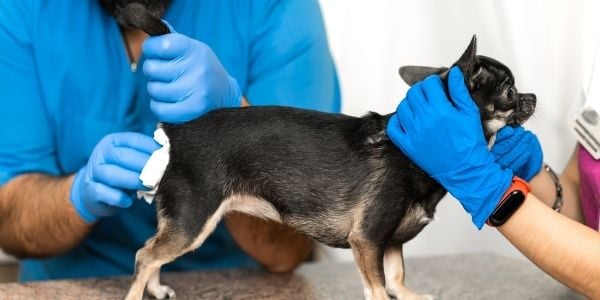
Your vet will explain the likely crusade(s) of your dog's anal gland issues. The crusade may be as elementary as your pet had a change in stool compactness or diarrhea from a change in treats or nutrient. The loose stool prevented your domestic dog from fully expressing their anal glands, and therefore they developed an anal gland infection.
If your pet is overweight, your veterinarian volition probable discuss your pet's diet (the blazon of nutrient and the quantity) and their exercise needs. In addition to food and exercise recommendations, your veterinarian may recommend blood work to decide other potential causes of excessive weight gain in your dog.
Such atmospheric condition include, but are non limited to, hypothyroidism or Cushing'southward disease. If there are skin bug, your veterinarian may recommend your dog beginning on a special diet (commercially produced veterinary prescribed limited ingredient nutrition or a true hypoallergenic nutrition). NOTE: Grain Free diets are non the same equally true hypoallergenic diets. Pets are typically, though not always, allergic to a type of protein such as chicken, beefiness, soy, etc.
If your pet is given antibiotics for an anal gland infection – often a two-week course – be sure to accept your pet rechecked by your veterinary to exist sure that the infection is cleared BEFORE the antibiotics are stopped. Some other expression is usually washed to make up one's mind if the infection is cleared or not.
Manage your dog'southward weight and consistency in nutrition
Maintaining your dog at an ideal body weight is not only helpful for anal gland bug, it's helpful for then many other weather condition, like degenerative joint affliction (arthritis). Your veterinarian can guide you to the best weight range for your dog. Supplement your dog with joint supplements if they are overweight or older. It volition help them walk and squat amend. I have establish Nutramax products to be the well-nigh consistent in their performance: Cosequin and Dasequin. Annotation: If your pet is diabetic, check with your veterinarian before choosing a articulation supplement.
Go on your pet'southward main nutrition and treats consistent. Don't switch things around weekly for multifariousness. Their systems do non accommodate like ours, and they can easily develop diarrhea.
If your dog is suffering from anal gland issues, do non give them rawhides, sus scrofa ears, bully sticks, or whatever other like treats. I have found that they tin exist hard to digest (besides, some tin be very greasy), they overstimulate the pancreas and and then crusade diarrhea. Then the bicycle of issues starts all over again.
Add together fiber to your domestic dog's nutrition
Something equally simple every bit organic, no- to low-sodium canned green beans – cooked or uncooked without any boosted seasoning. The added cobweb helps bulk up the stool and therefore makes expressing the anal glands easier. Depending on the size of your dog, you lot tin requite 1/viii to ½ a cup per meal (more than beans for a bigger butt!).
Another fiber source is canned pumpkin (not the pie mix, which has spices and sugar). BUT use circumspection on how much you lot utilize because information technology tin cause diarrhea if you give besides much. Showtime small and work your way upwards; cease before diarrhea starts. Normally, again depending on the size of your pet, first with ½ tsp twice to 3 times per solar day. Every few days, increase the amount (just go upwardly past a ¼ to ½ tsp per day total) while monitoring your pet's poop. If you notice that the stool is getting less business firm, cut dorsum to the amount when it seemed firm.
There are also psyllium fiber supplements. You can sprinkle the psyllium fiber onto your dog's nutrient. Since every domestic dog and situation is different, talk to your veterinarian about the correct amount to add for your dog, and you tin inquire them to recommend a high fiber nutrition if you desire to try that instead.
NOTE: Please remember, with high-cobweb diets or supplements, y'all must be sure that at that place is plenty of fresh water available for your pet.
Note: If y'all go a fiber production other than the ones recommended in this article, like Metamucil, make 100% sure that it doesn't contain the sweetener xylitol. Xylitol is extremely toxic to dogs, even at very depression doses. And it is NOT an artificial sweetener, so don't presume it'southward safe simply because the packaging says, "No Bogus Sweeteners."
Recommended Fiber Supplements for Dogs
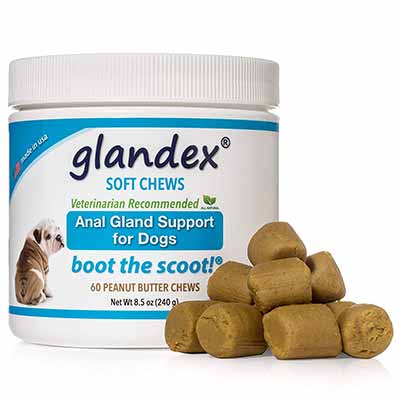
There are veterinary products that are specifically formulated for helping with this effect. Two such products are No Scoot and Glandex. Several of the Preventive Vet team'southward dogs use the Glandex chews, featured beneath, with proficient results.
Glandex soft chews for anal glands
Glandex pulverisation anal gland support

Pro Tip: If your dog has a suspected or known food hypersensitivity (food allergy) causing or worsening their anal gland problems, opt for the Glandex Peanut Butter chews rather than the beef flavored powder. Beef is a poly peptide source that can exist a common culprit for nutrient allergies in nutrient-sensitive dogs.
Add fish oil to your domestic dog's diet
Calculation fish oil to your dog'southward diet can help. And fish oil is also slap-up for their peel also as their joints. It acts every bit a natural anti-inflammatory. Honestly, even if your dog doesn't have anal gland issues, I recommend fish oil.
Recommended Fish Oils for Dogs
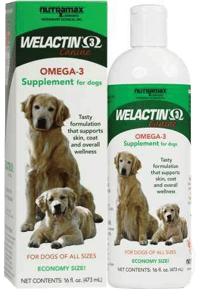
Nutramax Welactin – The high concentration of EPA and DHA Omega-3 fatty acids, equally well equally the tasty liquid format, make this fish oil a peachy and like shooting fish in a barrel-to-use supplement for dogs — just mix it in with either dry or canned nutrient. And it's made past Nutramax, a reputable and trusted brand inside the pet supplement manufacture.
Vetoquinol Omega – Fabricated by another trusted veterinarian supplement make, these Omega fatty acid capsules are an fantabulous choice for people who want to give fish oil supplements to their dogs in capsule form. Brand certain to purchase the size that's appropriate for the size of your dog. It comes in small-scale, medium, large, and giant brood sizes, as well every bit for cats, so choose the size advisable for your pet.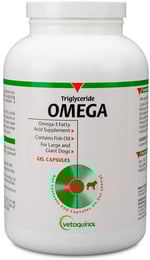
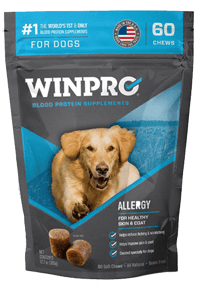
Recommended Blood Protein Supplements for Dogs
Supplements that apply blood proteins that are rich in immunoglobulins may assist reduce inflammation, promote healing, and provide other benefits for dogs. The WINPRO line of supplements (Immunity, Mobility, Allergy, Focus, Training) has been met with very positive feedback from canis familiaris owners. In our own experience, our dogs love the taste of their supplements. You only give your domestic dog ane or 2 (depending on their weight) each day then a purse of 60 will concluding you 1–two months. You should not give your dog more than the recommended amount.
How to Express Anal Glands
This is a chore near pet owners do not bask. It's a job oft best left to trained veterinarian team members. However, y'all can ask your veterinarian if they will teach you the proper style to express anal glands – the internal method.
I must warn you that this is not for the overnice! Information technology tin can be evil-smelling and messy. Also, if you acquire how to do it, exercise not limited your pet's glands before going out or having company over. Information technology never fails that you lot volition go the foul-smelling secretions on yourself or on something in the surrounding area. Be certain to go the recommended "cleaning" supplies listed below. Every bit a concluding note, if you decide to learn how to internally limited your pet's glands, BE Careful not to repeatedly or aggressively express them (squeeze too hard) because there is a risk of some degree of inflammation and tissue harm.
External Anal Gland Expression
I practise not recommend you express your dog's anal glands using theexternal method for the reasons I mentioned above about groomers doing it and the problems that information technology causes. Information technology pushes the secretions deeper into the gland, creating inflammation in the gland as well as the surrounding tissue. This inflammation causes the small-scale duct opening to be further blocked off. Therefore, making information technology hard, if not impossible, for your pet to express the glands themselves.
Internal Anal Gland Expression
Here's a skillful video, where our friends at Glandex testify you how to express your dog's anal glands at abode. Two notes to add nigh the video though: (1) I recommend using a bit of lube (Surgilube, Vaseline, or KY) on your finger when doing this method, and (2) I recommend having a wipe or newspaper towel in your mitt, covering the rectum, whenever expressing the anal glands — regardless of whether yous're doing the "external" or "internal" method, success tin can be VERY messy!!
How to express/squeeze canis familiaris anal glands
How Often Should Anal Glands Be Expressed?
Ideally, never having to limited the anal glands manually would be the all-time for everyone! All kidding aside, the less often, the better. If your dog has simply had an issue once and the infection is cleared, they may never take a problem once more, especially if the cause can exist identified and corrected. I ordinarily recommend having the glands checked once, almost four weeks after existence cleared of the infection. If your pet seems fine from that point on with none of the indicator signs axiomatic, leave them alone.
If, however, your pet has had a few episodes, I recommend later on the infection is cleared, recheck about every iv weeks for a few months (also, during this time, try to implement some of the prevention methods recommended above). If at each visit there announced to exist no bug, begin to gradually extend the flow of fourth dimension between expressing the glands. For example, wait 6 weeks between if that seems to work, endeavor extending to 8 weeks, etc.
But at the get-go sign of scooting or dragging their barrel, be certain to have your pet checked. Sometimes if you address information technology shortly plenty, they just need help expressing the glands without an infection developing. Also, I recommend, if your pet has had loose stool or diarrhea (hint: monitor their stool regularly during the week), get the glands expressed once information technology has cleared simply as a precaution.
Gloves and Cleanup
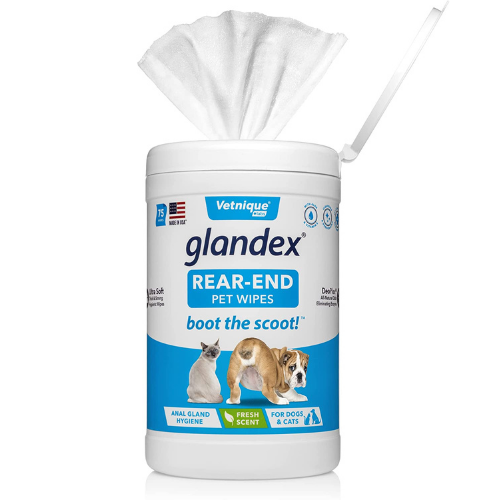
If you find that you need to express your canis familiaris's anal glands manually, you tin can check the video higher up to learn how to do so at abode. But beginning, make sure you're loaded upwards on the necessary supplies. Catch a supply of latex-free, powder-free gloves as well as some things to clean upwards afterward and deal with the odor, such as waterless shampoo or "barrel deodorizer" – you can spray it both on your pet'southward butt and in the air, and fifty-fifty on the carpets/floors/walls/drapes if anything from the anal glands squirts by your paper towel. These Glandex wipes have vitamin E and conditioners, too every bit a deodorizer. These wipes are used a lot in veterinary practices.
Glandex anal gland wipes with vitamin East
What Are Anal Glands and Why Do Dogs Have Them?
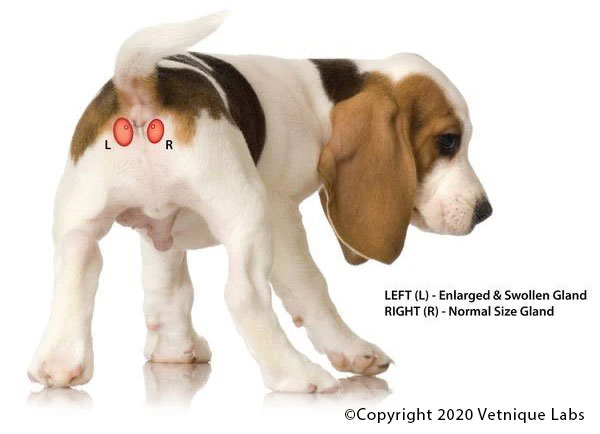
Anal glands are olfactory property glands – some people refer to them as "anal sacs." They range in size from a pea to a kidney edible bean, based on the size of your dog. They're located on either side of the anus and lie between the external anal sphincter and the smoothen muscle of the rectum. These glands are lined with secretory-blazon cells, which take numerous modified sweat and sebaceous (oil) glands. These ii features within the lining of the gland produce the lovely foul-smelling liquid that contributes to the issues.
When all is right with the earth, these glands are emptied when your canis familiaris (or cat) poops considering the external anal sphincter compresses the glands against the feces (good old poop) within the rectum (this indicate will become important to call up later!). And the sacs empty as a result.
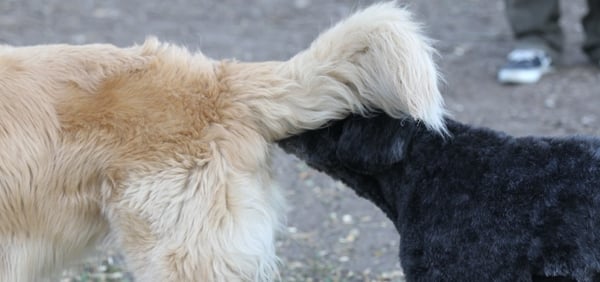
The purpose of all this is and then that dogs can mark their territory. The olfactory property left backside on their poop acts every bit a "smell bespeak" for other dogs passing by. Information technology is also involved with social interaction – the reason dogs sniff each other'south butts! Since each domestic dog's aroma is unique to them, by sniffing each other they larn things like: accept they met before, is this domestic dog a friend or foe, or practice I like them. Oh, nature and its wonderful way of communication! And then, as you tin see, they DO serve a purpose, even if it isn't a pleasant-smelling ane.
Ruptured anal glands
If your pet's anal glands should rupture, there will be some blood and possibly pus, plus yous will notice a small hole about their rectum. Either ane or both glands tin can rupture. The opening ordinarily sits, in relation to the rectum, at 4 and 8 o'clock or 5 and 7 o'clock. And one gland is e'er college than the other. While you may understandably panic when you first detect it and your dog may be whimpering, it is typically not an emergency situation. Although, I recommend calling your veterinarian and seeking medical communication.
Attempt not to permit your dog lick, chew, or rub the area earlier visiting your veterinarian. Putting an due east-neckband (cone) on them will help. When talking to the veterinarian, be certain to be detailed in your description of the site and your domestic dog's health history. This will help them know all-time how to suggest y'all on the adjacent course of activity. Typically, when the anal gland ruptures, antibiotics and hurting medication are needed. As well, depending on the size of the hole, surgery may be needed to close the opening.
Removing anal glands
There are some cases when a pet has chronically (continual and long-term) infected or impacted anal glands. When this happens, your veterinarian may recommend removing the glands – this is called an Anal Sacculectomy. I recommend having your veterinarian explain to you all potential side furnishings of the process before having it done so that you are completely enlightened and fully informed of all the risks and side effects.
I possible side effect is fecal incontinence – meaning your pet will take potentially picayune to no control over their ability to poop. Information technology could just happen "out of the bluish," without alarm. There is too the adventure of infection, dehiscence (opening of the surgical site due to location), anal stricture (narrowing or closure), rectal prolapse (protrusion or falling out of rectal tissue/membranes) likewise equally some others.
As well, be sure you are fully enlightened of all the costs, including those pre-operatively and postal service-operatively (especially if complications arise). While these side furnishings and costs can seem concerning, your veterinarian'southward recommendation is based on what they feel is the best medical care for your dog to live a long, happy, and good for you life.
Some general practice veterinarians are comfortable with and tin can practice the anal sacculectomy process, only some may suggest referral to a board-certified veterinary surgeon to minimize risks of complications arising.
Source: https://www.preventivevet.com/dogs/anal-glands-what-to-do-when-they-are-a-problem
0 Response to "I Expressed My Large Dogs Anal Glands 2 Weeks Ago and Theyre Full Again"
Post a Comment