Which of the Following Is a Factor in the Increase of Single-parent Families in North America?
A single parent is a person who lives with a child or children and who does non take a spouse or alive-in partner. Reasons for becoming a single parent include divorce, break-upwardly, abandonment, domestic violence, rape, death of the other parent, childbirth by a single person or single-person adoption. A unmarried parent family unit is a family with children that is headed by a single parent.[one] [2] [3] [4]
History [edit]
Single parenthood has been common historically due to parental mortality rate due to disease, wars, homicide, work accidents and maternal mortality. Historical estimates indicate that in French, English, or Spanish villages in the 17th and 18th centuries at to the lowest degree one-third of children lost one of their parents during childhood; in 19th-century Milan, almost half of all children lost at to the lowest degree one parent past age 20; in 19th-century China, near one-third of boys had lost one parent or both by the age of 15.[v] Such single parenthood was often short in elapsing, since remarriage rates were high.[6]
Divorce was by and large rare historically (although this depends by culture and era), and divorce especially became very difficult to obtain after the fall of the Roman Empire, in Medieval Europe, due to strong interest of ecclesiastical courts in family life (though annulment and other forms of separation were more than common).[vii]
Demographics [edit]
Households [edit]
Amongst all households in OECD countries in 2011, the proportion of single-parent households was in three-xi% the range, with an average of 7.5%. Information technology was highest in Commonwealth of australia (x%), Canada (10%), Mexico (10%), United States (10%), Republic of lithuania (10%), Republic of costa rica (eleven%), Republic of latvia (11%) and New Zealand (eleven%), while information technology was lowest in Nihon (iii%), Hellenic republic (4%), Switzerland (4%), Bulgaria (5), Croatia (five%), Germany (v%), Italy (5%) and Cyprus (five%). The proportion was nine% in both Republic of ireland and the United Kingdom.[eight]
Amongst households with children in 2005/09, the proportion of single-parent households was 10% in Nihon, xvi% in kingdom of the netherlands, 19% in Sweden, xx% in France, 22% in Denmark, 22% in Germany, 23% in Ireland, 25% in Canada, 25% in the United Kingdom, and xxx% in the Us. The U.S. proportion increased from 20% in 1980 to 30% in 2008.[9]
In all OECD countries, nigh single-parent households were headed by a female parent. The proportion headed past a father varied between 9% and 25%. It was lowest in Estonia (9%), Costa Rica (10%), Republic of cyprus (10%), Japan (10%), Ireland (10%) and the United kingdom of great britain and northern ireland (12%), while it was highest in Kingdom of norway (22%), Espana (23%), Sweden (24%), Romania (25%) and the United states of america (25%). These numbers were non provided for Canada, Australia or New Zealand.[8]
Children [edit]
In 2016/17, the proportion of children living in a single-parent household varied between 6% and 28% in the different OECD countries, with an OECD country average of 17%. It was lowest in Turkey (2015, half dozen%), Greece (viii%), Croatia (8%) and Poland (x%), while it was highest in French republic (23%), United kingdom of great britain and northern ireland (23%), Belgium (25%), Republic of lithuania (25%), U.s. (27%) and Latvia (28%). It was 19% in Ireland and Canada.[10]
Among children living in a single-parent household, most live primarily with their mother, others primarily with their father, while other children have a shared parenting arrangement where they spend an approximately equal amount of time with their two parents. Among those living primarily with 1 single parent, nigh live with their mother. In 2016 (or latest yr bachelor), the proportion of 6-12 yr olds living primarily with their single father ranged between 5% and 36% among the different OECD countries. It was highest in Belgium (17%), Iceland (nineteen%), Slovenia (twenty%), French republic (22%), Norway (23%) and Sweden (36%), while it was lowest in Lithuania (4%), Ireland (v%), Poland (5%), Republic of estonia (vii%), Republic of austria (vii%) and the United Kingdom (eight%). It was 15% in the United States.[eleven]
In 2005/06, the proportion of eleven- to 15-yr-erstwhile children living in a shared parenting arrangement versus with only one of their parents varied between 1% and 17%, being the highest in Sweden. It was v% in Ireland and the United States, and 7% in Canada and the United Kingdom.[12] By 2016/17, the pct in Sweden had increased to 28%.[xiii]
Impact on parents [edit]
Single mothers [edit]
Over 9.5 1000000 American families are run by 1 woman. Unmarried mothers are likely to have mental wellness issues, financial hardships, live in a low income area, and receive low levels of social support. All of these factors are taken into consideration when evaluating the mental health of unmarried mothers. The occurrence of moderate to severe mental inability was more pronounced among unmarried mothers at 28.seven% compared to partnered mothers at 15.7%.[14] These mental disabilities include only are not limited to anxiety and depression. Financial hardships also affect the mental wellness of unmarried mothers. Women, ages fifteen–24, were more than probable to live in a low socio-economic surface area, take one child, and not to have completed their senior year of high school. These women reported to be in the two lowest income areas, and their mental health was much poorer than those in college income areas.[xiv]
A like study on the mental health of single mothers attempted to answer the question, "Are there differences in the prevalence of psychiatric disorders, between married, never-married, and separated/divorced mothers?" Statistically, never married, and separated/divorced mothers had the highest regularities of drug corruption, personality disorder and PTSD.[15] The family unit construction can become a trigger for mental health issues in single mothers. They are especially at risk for having higher levels of depressive symptoms.[16]
Studies from the 1970s showed that unmarried mothers who are non financially stable are more likely to experience depression.[17] In a more than current study it was proven that financial strain was directly correlated with sky rocket levels of depression.[17] Amongst low-income, unmarried mothers, depressive symptoms may be as loftier as threescore%.[eighteen]
Inadequate access to mental health care services is prevalent amidst impoverished women. Depression-income women are less likely to receive mental health care for numerous reasons. Mental health services remain inequitable for low-income, more then, depression-income single women are more likely to suffer from depression, anxiety, and other poor mental wellness outcomes. Researchers Copeland and Snyder (2011) addressed the barriers depression-income single mothers have on receiving mental health care, "Visible barriers often include the lack of customs resources, transportation, child care, convenient hours, and financial resources." Meanwhile, low-income unmarried mothers are more likely to bring their children in for mental health treatment than themselves. Researchers Copeland and Snyder analyzed 60-iv African American mothers who brought their children in for mental health treatment. These mothers were and so screened for mild, moderate, and astringent low and/or feet. After three months the researchers used an ethnographic interview to accost whether or not the participants used mental health services that were referred to them. Results indicated that the majority of the participants did non use the referred mental health care services for reasons that included: fear of losing their children, being hospitalized and/or stigmatized by their community counterparts.[19]
Impact on children [edit]
According to David Blankenhorn,[twenty] Patrick Fagan,[21] Mitch Pearlstein[22] David Popenoe[23] and Barbara Dafoe Whitehead,[24] living in a single parent family is strongly correlated with school failure and problems of delinquency, drug use, teenage pregnancies, poverty, and welfare dependency in the United states of america. Using multilevel modelling, Suet-Ling Pong has shown that a high proportion of American children from single parent families perform poorly on mathematics and reading achievement tests.[25] [26]
In Sweden, Emma Fransson et al. take shown that children living with 1 single parent have worse well-existence in terms of physical wellness behavior, mental health, peer friendships, bullying, cultural activities, sports, and family relationships, compared to children from intact families. Equally a contrast, children in a shared parenting system that alive approximately equal amount of time with their divorced female parent and father have most the same well-beingness equally children from intact families and better outcomes than children with merely one custodial parent.[27]
The U.k. Role for National Statistics has reported that children of unmarried parents, after decision-making for other variables similar family income, are more than likely to have problems, including being twice as likely to suffer from mental illness.[28] Both British and American researchers testify that children with no fathers are three times more likely to be unhappy, and are as well more than likely to appoint in anti-social behavior, abuse substances and engage in juvenile deliquency.[29] [30]
Affect on American society [edit]
In 2017, the U.South Demography Bureau published a report breaking downward the number of children living in single parent households by the race of the family unit. The report found dramatic disparities in the rates of unmarried parent families amid the races examined.[31]
Cultural norms and attitudes [edit]
There is some debate amongst experts as to what the important component of the family structure is, particularly in the The states, centring on whether or non a complete family or the dearest and affection of the children'due south parents is more than important. At that place are even some that argue that a single-parent family is not fifty-fifty actually a family unit.[32] In the United States, where living standards are mostly high, unmarried-parent households are on average much poorer, a pattern largely explained past the lack of a second source of income in the abode itself.[33] With respect to this, recent public policy debates have centered on whether or not government should give aid to unmarried parent households, which some believe will reduce poverty and meliorate their situation, or instead focus on wider issues like protecting employment.[34] In addition, there is a debate on the behavioral effects of children with incarcerated parents, and how losing one or both parents to incarceration affects their academic performance and social well-being with others.[35]
It is encouraged that each parent respects the other, at to the lowest degree in the child's presence[ by whom? ], and provide child back up for the primary caregiver, when parents are not married or separated.[34] [36] The ceremonious behaviour among separated parents has a direct effect on how the child copes with their state of affairs; this is especially seen in younger children who practice not withal understand their familial separation, requiring both parents to establish a limited friendship to support the upbringing of their kid.[36]
Causes of single-parenthood [edit]
Widowed parents [edit]

Statue of a mother at the Yasukuni Shrine, dedicated to war widows who raised their children alone
Historically, death of a partner was a common crusade of unmarried parenting. Diseases and maternal death not infrequently resulted in a widower or widow responsible for children. At sure times wars might also deprive pregnant numbers of families of a parent. Improvements in sanitation and maternal intendance have decreased mortality for those of reproductive age, making expiry a less common cause of unmarried parenting.
Divorced parents [edit]
Divorce statistics [edit]
In 2009, the overall divorce rate was effectually ix/1000 in the U.s.. It was likewise constitute that more than influence came from the s, with the rates there being about 10.5/yard, every bit opposed to the north where it was effectually 7/1000.[37] This resulted in nearly one.5% (around one million) children living in the house of a recently divorced parent in the same year.[38] Along with this, it has been shown that for the past 10 years or then, first marriages have a 40% gamble of ending in divorce.[ citation needed ] And, for other marriages after a kickoff divorce, the chance of another divorce increases. In 2003, a study showed that virtually 69% of children in American living in a household that was a dissimilar structure than the typical nuclear family. This was broken downward into about 30% living with a stepparent, 23% living with a biological mother, 6% with grandparents as caregivers, iv% with a biological male parent, 4% with someone who was not a direct relative, and a pocket-size i% living with a foster family.[39]
Around the mid-1990s, there was a significant amount of single parents raising children, with one.3 million single fathers and seven.6 meg unmarried mothers in the U.s. alone.[ citation needed ] However, many parents want, or try, to get sole custody, which would brand them a single parent, simply are unsuccessful in the court procedure. There are many parents who may single parent, but exercise so without official custody, farther biasing statistics.
Children and divorce [edit]
Child custody in reference to divorce refers to which parent is allowed to brand important decisions about the children involved. Physical custody refers to which parent the child lives with. Among divorced parents, "parallel parenting" refers to parenting after divorce in which each parent does so independently; this is most common. In comparison, cooperative parenting occurs when the parents involved in the kid'due south life work together around all involved parties' schedules and activities, and this is far less common. Afterward a sure "crisis period," most children resume normal development; however, their future relationships are often afflicted, as they lack a model upon which to base a healthy long-term relationship. Nevertheless, every bit adults children of divorcees cope better with change.[40] [41] [42]
Children are afflicted by divorce in many dissimilar means, varying past the circumstances and historic period of the child. Young children ages two to six are mostly the most fearful of parental separation, and often feel abandoned or dislocated. Both boys and girls have the same amount of trouble coping, but oftentimes evidence this in unlike means. Nonetheless this age group adapts best to their situations, every bit they are oftentimes as well young to remember their non-custodial parent vividly. Children ages seven to twelve are much amend at expressing emotions and accepting parentage breakage, only oftentimes distrust their parents, rely on outside assistance and support for encouragement, and may manifest social and academic problems. Adolescents cope the worst with divorce; they often struggle most with the change, and may even plough away from their family entirely, dealing with their situation on their own. They ofttimes have problems expressing feelings, similar to far younger children, and may have aligning issues with long-term relationships due to these feelings.[43] Keeping in touch with both parents and having a healthy relationship with both mother and father appears to have the about effect on a child's behavior; which leads to an easier time coping with the divorce also equally development through the child'south life.[44] Children will do improve with their parents divorce if they have a smooth aligning period. 1 way to make this adjustment easier on children is to let them "remain in the same neighborhoods and schools following divorce."[45]
Single woman births [edit]
Unintended pregnancy [edit]
Some out-of-wedlock births are intended, but many are unintentional. Out-of-marriage births are frequently not adequate to society, and they frequently result in single parenting. A partner may also leave as he or she may want to shirk responsibility of bringing up the child. This also may damage the kid.[46] Where they are not acceptable, they sometimes result in forced marriage, however such marriages fail more than often than others.
In the United States, the rate of unintended pregnancy is higher among unmarried couples than among married ones. In 1990, 73% of births to unmarried women were unintended at the fourth dimension of conception, compared to most 44% of births overall.[47]
Mothers with unintended pregnancies, and their children, are field of study to numerous adverse wellness effects, including increased chance of violence and death, and the children are less likely to succeed in school and are more likely to live in poverty and be involved in crime.
"Fragile Families" are ordinarily caused by an unintended pregnancy out of wedlock. Unremarkably in this situation the father is not completely in the picture and the relationship betwixt the mother, father, and kid is consistently unstable. As well as instability "fragile families" are often limited in resources such equally human capital and financial resources, the kids that come from these families are more likely to be hindered within school and don't succeed equally well as kids who accept strictly single parents or two parent homes.[48] Unremarkably inside these families the male parent plans to stick around and help raise the child but once the child is born the fathers do not stay for much longer and simply one third stay subsequently five years of the kid'due south nascence.[49] About of these delicate families come from low economic status to begin with and the cycle appears to go along; once the child grows upwardly they are just as probable to still be poor and live in poverty as well.[50] Most fragile families end with the mother becoming a single parent, leaving it fifty-fifty more difficult to come out of the poverty cycle. The gender of the baby seems to have no issue if the male parent is non living with the mother at the fourth dimension of the birth, meaning they are still likely to leave after one year of the child'due south nascence. Nevertheless at that place is some bear witness that suggests that if the father is living with the mother at the fourth dimension of the nascence he is more likely to stay after one yr if the child is a son rather than a daughter.[51]
Choice [edit]
Some individuals choose to become significant and parent on their ain. Others cull to prefer. Typically referred to in the Westward every bit "Single Mothers past Choice" or "Pick Moms" though, fathers also (less usually) may choose to become single parents through adoption or surrogacy. Many turn to single parenthood by choice later on not finding the right person to raise children with, and for women, it often comes out of a desire to have biological children earlier it is as well late to practise and so.
Single-parent adoption [edit]

A single mother and kid
History of unmarried parent adoptions [edit]
Single parent adoptions take existed since the mid 19th century. Men were rarely considered as adoptive parents, and were considered far less desired. Often, children adopted by a single person were raised in pairs rather than alone, and many adoptions by lesbians and gay men were bundled every bit single parent adoptions. During the mid 19th century many state welfare officials made it difficult if not impossible for single persons to adopt, every bit agencies searched for "normal" families with married men and women. In 1965, the Los Angeles Bureau of Adoptions sought single African-Americans for African-American orphans for whom married families could not be found. In 1968, the Child Welfare League of America stated that married couples were preferred, but at that place were "exceptional circumstances" where single parent adoptions were permissible.[52]
Not much has inverse with the adoption process since the 1960s. All the same, today, many countries merely permit women to prefer as a single parent, and many others only allow men to adopt boys.[53]
Considerations [edit]
Single parent adoptions are controversial. They are, withal, all the same preferred over divorcees, every bit divorced parents are considered an unnecessary stress on the child.[54] In 1 written report, the interviewers asked children questions about their new lifestyle in a unmarried-parent home. The interviewer found that when asked near fears, a loftier proportion of children feared illness or injury to the parent. When asked about happiness, half of the children talked virtually outings with their unmarried adoptive parent.[55] A single person wanting to adopt a child has to be mindful of the challenges they may face, and there are certain agencies that will not work with single adoptive parents at all. Single parents will typically but have their own income to live off of, and thus might not accept a fill-in plan for potential children in case something happens to them.[56] Traveling is also fabricated more complex, equally the child must either exist left in someone else'south care, or taken forth.[57]
By country [edit]
Australia [edit]
In 2003, fourteen% of all Australian households were single-parent families.[58] In Australia 2011, out of all families 15.9% were single parent families. Out of these families 17.6% of the single parents were males, whilst 82.4% were females.[59]
Single people are eligible to apply for adoption in all states of Commonwealth of australia, except for Queensland and Southward Australia. They are able to apply for adoption both to Australian born and international born children, although not many other countries let single parent adoptions.[60]
Single parents in Australia are eligible for support payments from the authorities, but only if they are caring for at to the lowest degree 1 kid under the age of 8.[61]
New Zealand [edit]
At the 2013 demography, 17.eight% of New Zealand families were single-parent, of which five-sixths were headed by a female person. Unmarried-parent families in New Zealand have fewer children than 2-parent families; 56% of single-parent families accept only ane child and 29% have two children, compared to 38% and forty% respectively for two-parent families.[62]
United Kingdom [edit]
In the United kingdom, almost one out of 4 families with dependent children are unmarried-parent families, 8 to eleven per centum of which have a male person unmarried-parent.[63] [64] [65] UK poverty figures show that 52% of single parent families are below the Government-defined poverty line (afterwards housing costs).[66] Single parents in the UK are almost twice as likely to be in low-paid jobs equally other workers (39% of working unmarried parents compared with 21% of working people nationally). This is highlighted in a written report published by Gingerbread, funded past Trust for London and Barrow Cadbury Trust.[67]
United states [edit]
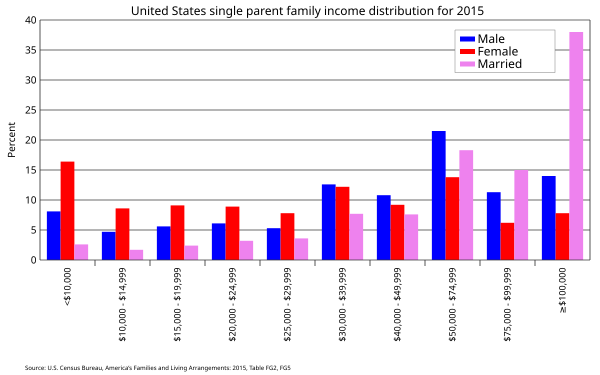
In the U.s.a., since the 1960s, there has been a marked increase in the number of children living with a single parent. The jump was caused by an increase in births to unmarried women and by the increasing prevalence of divorces amidst couples. In 2010, forty.seven% of births in the Usa were to unmarried women.[68] In 2000, eleven% of children were living with parents who had never been married, 15.6% of children lived with a divorced parent, and i.2% lived with a parent who was widowed.[69] [70] The results of the 2010 U.s. Census showed that 27% of children alive with one parent, consistent with the emerging trend noted in 2000.[71] The most contempo data of December 2011 shows approximately thirteen.7 million unmarried parents in the U.S.[72] Mississippi leads the nation with the highest per centum of births to unmarried mothers with 54% in 2014, followed by Louisiana, New Mexico, Florida and S Carolina.[73]
In 2020, 10.seven million families in the US were headed by a single parent with children nether the historic period of eighteen, 80% of which were headed by a female person. [74] [75]
The newest census agency reports that between 1960 and 2016, the percentage of children living in families with two parents decreased from 88 to 69. Of those fifty.7 meg children living in families with two parents, 47.seven million live with two married parents and three.0 million live with ii unmarried parents.[76]
The percentage of children living with single parents increased substantially in the United States during the second one-half of the 20th century. According to a 2013 Kid Trends study, only nine% of children lived with single parents in the 1960s—a figure that increased to 28% in 2012.[77] The principal cause of unmarried parent families are high rates of divorce and non-marital childbearing.
India [edit]
The Supreme Court of India and diverse High Courts of Republic of india take recognized the rights of unmarried mothers to requite nascency and raise children.[78] [79] The High Courtroom of Kerala, has alleged in a case argued past Advocate Aruna A. that, the birth registration authorities cannot insist on the details of the father for registration of nativity of a kid born to a single mother, conceived through IVF.[80] [81]
See besides [edit]
- Cost of raising a kid
- Family unit
- Family unit planning
- Marriage gap
- Shared parenting
- Unmarried (relationship)
- Sole custody
- Teenage pregnancy
References [edit]
- ^ Miriam-Webster Dictionary unmarried parent, noun
- ^ Collins English Dictionary single parent
- ^ Usa Legal, Single Parent Law and Legal Definition
- ^ The Social History of the American Family: An Encyclopedia, Single-Parent Families, Sage Publications
- ^ Gay Brunet. "Orphans". Encyclopedia of Children and Childhood in History and Society. Internet FAQ Archives.
- ^ Dupaquier J, Helin Due east, Laslett P, Livi-Bacci Grand, Marriage and remarriage in populations of the by, London: Academic Printing, 1981.
- ^ Kent's Commentaries on American Law, p. 125, due north. i (14th ed. 1896).
- ^ a b OECD Family unit Database, SF1.1:Family size and household composition, OECD -Social Policy Sectionalization -Advisers of Employment, Labour and Social Affairs, June 12, 2016.
- ^ "Tabular array 1337. Single-Parent Households: 1980 to 2009" (PDF). world wide web.census.gov. United states Census Bureau, Statistical Abstract of the United States: 2012. Archived from the original (PDF) on eighteen February 2015. Retrieved 4 November 2014.
- ^ OECD -Social Policy Sectionalisation -Advisers of Employment, Labour and Social Affairs, OECD Family Database, Chart SF1.2.A. Living arrangements of children, 2017
- ^ OECD -Social Policy Division -Advisers of Employment, Labour and Social Affairs, OECD Family unit Database, Table SF1.3.A. Living arrangements of children by age
- ^ Bjarnason T, Arnarsson AA. Articulation Physical Custody and Advice with Parents: A Cross-National Written report of Children in 36 Western Countries Archived 2017-eleven-19 at the Wayback Automobile, Journal of Comparative Family Studies, 2011, 42:871-890.
- ^ Statistics Sweden, Barns boende (växelvis boende, hos mamma, hos pappa, etc.) 2012—2017, November xi, 2018.
- ^ a b Brownish, George Westward.; Moran, Patricia 1000. (1997-01-01). "Single mothers, poverty and low". Psychological Medicine. 27 (1): 21–33. doi:x.1017/s0033291796004060. ISSN 1469-8978. PMID 9122302.
- ^ Afifi, Tracie O.; Cox, Brian J.; Enns, Murray Due west. (2006-02-09). "Mental health profiles among married, never-married, and separated/divorced mothers in a nationally representative sample". Social Psychiatry and Psychiatric Epidemiology. 41 (two): 122–129. doi:x.1007/s00127-005-0005-3. ISSN 0933-7954. PMID 16467954. S2CID 37493744.
- ^ Jayakody, Rukmalie; Stauffer, Dawn (2000-01-01). "Mental Health Problems Amidst Single Mothers: Implications for Work and Welfare Reform". Journal of Social Issues. 56 (iv): 617–634. doi:10.1111/0022-4537.00188. ISSN 1540-4560. S2CID 2946124.
- ^ a b Belle, Deborah (1990-03-01). "Poverty and women'southward mental health". American Psychologist. 45 (three): 385–389. doi:10.1037/0003-066X.45.iii.385. ISSN 1935-990X.
- ^ Peden, Ann R.; Rayens, Mary Kay; Hall, Lynne A.; Grant, Elizabeth (2004-12-01). "Negative Thinking and the Mental Health of Low-Income Single Mothers". Journal of Nursing Scholarship. 36 (iv): 337–344. doi:10.1111/j.1547-5069.2004.04061.10. ISSN 1547-5069. PMID 15636414.
- ^ Copeland, Valire C. & Kimberly Snyder. 2011. "Barriers to Mental Health Treatment Services for Depression-Income African American Women Whose Children Receive Behavioral Wellness Services: An Ethnographic Investigation." Social Work in Public Wellness 26:1, 78–95
- ^ Blankenhorn, 1995 D. Blankenhorn Fatherless America: Confronting Our Most Urgent Social Problem Basic Books, New York (1995)
- ^ "How Broken Families Rob Children of Their Chances for Future Prosperity". The Heritage Foundation . Retrieved 2017-01-18 .
- ^ K. Pearlstein From Family Collapse to America's Decline: The Educational, Economic, and Social Costs of Family Disintegration Rowman & Littlefield, New York, NY (2011)
- ^ D. Popenoe Families without Fathers: Fathers, Spousal relationship, and Children in American Society Transaction Publishers, New Brunswick, NJ (2009)
- ^ B.D. Whitehead The Divorce Culture Alfred Knopf, New York (1997)
- ^ Pong SL. Family unit structure, schoolhouse context, and 8th-grade math and reading achievement. Journal of Union and the Family unit. 1997 Aug 1:734-46.
- ^ Pong SL. The school compositional effect of single parenthood on 10th-grade achievement. Sociology of education. 1998 Jan 1:23-42.
- ^ Fransson E, Låftman SB, Östberg V, Hjern A, Bergström M. The living conditions of children with shared residence–the Swedish example. Child Indicators Research. 2017 Jan:1-23.
- ^ David Batty (2006-02-21). "Single-parent families double likelihood of kid mental illness". the Guardian.
- ^ Thomas, George; Farrell, Michael P.; Barnes, Grace M. (1 January 1996). "The Furnishings of Single-Female parent Families and Nonresident Fathers on Malversation and Substance Abuse in Black and White Adolescents". Periodical of Marriage and Family. 58 (4): 884–894. doi:10.2307/353977. JSTOR 353977.
- ^ Gove, Walter R.; Crutchfield, Robert D. (1982). "The Family and Juvenile Malversation*". The Sociological Quarterly. 23 (3): 301–319. doi:10.1111/j.1533-8525.1982.tb01014.x. S2CID 143647741.
- ^ "Children in single-parent families past race | KIDS COUNT Data Heart". datacenter.kidscount.org . Retrieved 2019-05-13 .
- ^ Snowdon, Stacey (1997). "DIVORCE AND ITS Effects ON CHILDREN". Advocates for Children program, College Park Scholars, University of Maryland. Retrieved fourteen November 2011.
- ^ Thompson, Derek (Oct 1, 2013). "How America'southward Marriage Crunch Makes Income Inequality So Much Worse" – via The Atlantic.
- ^ a b "Nigh Single Parent". Single Parenting. April 23, 2011. Archived from the original on 12 December 2012. Retrieved 8 Nov 2012.
- ^ Reed, Diane and Edward. "Children of Incarcerated Parents". Social Justice, Fall 1997 v24 n3 p152(18). Archived from the original on 12 Oct 2011. Retrieved 14 November 2011.
- ^ a b Eagan, Cristina. "Zipper and Divorce: Family unit Consequences". Rochester Institute of Engineering. Retrieved 14 Nov 2011.
- ^ "The American South has the country'south highest divorce rates". GlobalPost. 25 August 2011. Retrieved 14 November 2011.
- ^ Yen, Promise (25 August 2011). "United States Divorce Rate: 2009 Census Report Reveals Startling Marriage Trends". Huffington Postal service . Retrieved 14 November 2011.
- ^ "Divorce Statistics". Archived from the original on 13 November 2011. Retrieved 14 November 2011.
- ^ Baker, A.L.; Ben-Ami, N. (2011). "Adult Recall of Babyhood psychological maltreatment in "Adult Children of divorce": Prevalence and associations with concurrent measures of well being". Periodical of Divorce & Remarriage. 52 (4): 203–219. doi:ten.1080/10502556.2011.556973. S2CID 143613787.
- ^ Thomas, D.A.; Woodside, Thou. (2011). "Resilience in adult children of divorce: A multiple case study". Marriage & Family Review. 47 (4): 213–234. doi:ten.1080/01494929.2011.586300. S2CID 144236587.
- ^ Cherlin, Andrew (2010). Public and Private Families. New York, NY: McGraw Hill. ISBN978-0-07-340435-vi.
- ^ Niolon, PhD, Richard. "Children of Divorce and Adjustment". Psych Page. Retrieved 29 November 2011.
- ^ Hess, Robert D.; Camara, Kathleen A. (1979-10-01). "Post-Divorce Family Relationships equally Mediating Factors in the Consequences of Divorce for Children". Journal of Social Problems. 35 (4): 79–96. doi:ten.1111/j.1540-4560.1979.tb00814.x. ISSN 1540-4560.
- ^ Amato, Paul R. (2014). "The Consequences of Divorce for Adults and Children: An Update". Društvena Istraživanja. 23: 5–24. doi:10.5559/di.23.one.01.
- ^ "Single Parent Households – How Does it Touch the Children?". Retrieved 23 April 2014.
- ^ Eisenberg, Leon; Brown, Sarah Hart (1995). The all-time intentions: unintended pregnancy and the well-being of children and families . Washington, D.C: National University Press. ISBN978-0-309-05230-half dozen.
- ^ Waldfogel, Jane; Craigie, Terry-Ann; Brooks-Gunn, Jeanne (2010-01-01). "Fragile Families and Child Wellbeing". The Future of Children. twenty (2): 87–112. doi:ten.1353/foc.2010.0002. ISSN 1054-8289. PMC3074431. PMID 20964133.
- ^ McLanahan, Sara; Beck, Audrey N. (2010-01-01). "Parental relationships in fragile families". The Futurity of Children. xx (2): 17–37. doi:10.1353/foc.2010.0007. ISSN 1054-8289. PMC3053572. PMID 20964130.
- ^ McLanahan, Sara (2009-01-01). "Fragile Families and the Reproduction of Poverty". The Annals of the American Academy of Political and Social Science. 621 (i): 111–131. doi:10.1177/0002716208324862. ISSN 0002-7162. PMC2831755. PMID 20204078.
- ^ Lundberg, Shelly; McLanahan, Sara; Rose, Elaina (2007). "Child gender and father involvement in delicate families". Census. 44 (1): 79–92. doi:10.1353/dem.2007.0007. ISSN 0070-3370. PMID 17461337. S2CID 21148498.
- ^ "Single Parent Adoptions". The Adoption History Project. University of Oregon. 24 February 2012. Retrieved 23 April 2014.
- ^ "Intercountry Adoption". U.S. Section of State, Agency of Consular Affairs. Retrieved 23 April 2014.
- ^ Block-Hanson-Cormell (2001). "Single Parent Adoptions: Why Non?". Adopting.org. Archived from the original on 6 December 2008. Retrieved 23 April 2014.
- ^ Shireman, Joan F.; Johnson, Renny R. (1985). "Single Parent Adoptions: A Longitudinal Study". Children and Youth Services Review. 7 (4): 321–334. doi:10.1016/S0190-7409(85)80005-0.
- ^ "Unmarried Parent Adoption". Adoption Services. Retrieved 23 April 2014.
- ^ "Single Parent Adoption: Challenges of Single Adoption". Adoptions Together. Retrieved 23 April 2014.
- ^ "One Parent Families". Australian Social Trends, 2007. 4102. 2007-07-08.
- ^ Statistics, c=AU; o=Commonwealth of Australia; ou=Australian Bureau of. "QuickStats details". www.abs.gov.au . Retrieved 2016-05-17 .
- ^ "Department for Child Protection – Western Commonwealth of australia – Thinking about adoption?". world wide web.dcp.wa.gov.au . Retrieved 2016-05-17 .
- ^ "Parenting Payment – Australian Regime Department of Human Services". world wide web.humanservices.gov.au . Retrieved 2016-05-17 .
- ^ "2013 Census QuickStats about families and households". Statistics New Zealand. 4 November 2014. Archived from the original on 13 November 2014. Retrieved 11 December 2014.
- ^ "Statistics". Gingerbread. 2010. Archived from the original on 24 December 2012. Retrieved eight November 2012.
- ^ Labour Marketplace Statistics, Labour Market Review 2006 – archived, United Kingdom Office for National Statistics, 23 March 2006
- ^ Full general Household Survey, 2005 Report, Part for National Statistics, 28 Nov 2006 – see Tabular array 3.6, Family unit type, and marital status of alone parents: 1971 to 2005.
- ^ Households Below Average Income (HBAI), Great britain Department of Work and Pensions, 14 June 2012
- ^ "Paying the price: The long route to recovery". Archived from the original on 2014-12-17.
- ^ "FastStats – Births and Natality". 2018-08-08.
- ^ O'Hare, Bill (July 2001). "The Rise – and Autumn? – of Single-Parent Families". Population Today. Archived from the original on 26 May 2013. Retrieved ix Nov 2011.
- ^ "Unmarried Parent Success Foundation". America's Children: Central National Indicators of Well-being. www.childstats.gov. Archived from the original on 16 November 2011. Retrieved 9 November 2011.
- ^ "More Young Adults are Living in Their Parents' Home, Demography Bureau Reports" (Press release). U.s.a. Census Bureau. 3 November 2011. Retrieved 23 April 2014.
- ^ "The Most Important Statistics About Unmarried Parents". The Bandbox . Retrieved 2017-12-06 .
- ^ "The Number of Births to Unmarried Mothers in Massachusetts is Higher than You Call back". Infinity Law Group. 2016-03-28. Retrieved 2016-03-28 .
- ^ "Unmarried Female parent Statistics". Unmarried Mother Guide.
- ^ Navarro, Mireya (September 5, 2008). "The Bachelor Life Includes a Family". The New York Times.
- ^ Bureau, US Census. "The Majority of Children Live With Two Parents, Census Bureau Reports". The The states Demography Bureau . Retrieved 2018-12-07 .
- ^ Amato, Paul R., Sarah Patterson, and Brett Beattie. "Single-Parent Households And Children'Southward Educational Accomplishment: A Country-Level Analysis." Social Science Inquiry 53.(2015): 191–202. SocINDEX with Full Text. Web. eighteen March. 2017.
- ^ Welle (www.dw.com), Deutsche. "Unmarried mothers in Republic of india non compelled to disclose male parent's identity: Supreme Courtroom | DW | 07.07.2015". DW.COM . Retrieved 2021-eleven-27 .
- ^ A, Aruna (2021-09-14). "Need to sympathize the rights of a unmarried female parent by choice". Legal Bay . Retrieved 2021-11-27 .
- ^ "No need for single female parent conceiving via IVF to give father's name on birth certificate: Kerala HC". The New Indian Express . Retrieved 2021-11-27 .
- ^ Aug 17, TNN /; 2021; Ist, 07:25. "Request sperm donor's name violates correct to privacy, says Kerala high court | Kochi News - Times of Bharat". The Times of India . Retrieved 2021-11-27 .
{{cite web}}: CS1 maint: numeric names: authors list (link)
Further reading [edit]
- Bankston, Carl Fifty.; Caldas, Stephen J. (1998). "Family Structure, Schoolmates, and Racial Inequalities in School Achievement". Journal of Union and the Family. 60 (3): 715–723. doi:10.2307/353540. JSTOR 353540. S2CID 144979354.
- Dependent Children: 1 in 4 in lone-parent families, National Statistics Online, National Statistics, United Kingdom, July 7, 2005, retrieved 17 July 2006
- "Family Life: Stresses of Single Parenting". American University of Pediatricians. Retrieved 8 November 2012.
- Federal Interagency Forum on Child and Family Statistics (20 July 2005). "America's Children: Family Structure and Children'due south Well-Being". Backgrounder.
- Geographic Distribution: London has most lone-parent families, National Statistics Online, National Statistics, United Kingdom, July 7, 2005, retrieved 17 July 2006
- Hilton, J.; Desrochers, Due south.; Devall, E. (2001). "Comparing of Role Demands, Relationships, and Child Performance is Unmarried-Female parent, Single-Father, and Intact Families". Periodical of Divorce and Remarriage. 35: 29–56. doi:10.1300/j087v35n01_02. S2CID 145109403.
- Lavie, Smadar (2014). Wrapped in the Flag of Israel: Mizrahi Unmarried Mothers and Bureaucratic Torture. Oxford and New York: Berghahn Books. ISBN 978-1-78238-222-5 hardback; 978-1-78238-223-2 ebook.
https://www.academia.edu/6799750/Wrapped_in_the_Flag_of_Israel_Mizrahi_Single_Mothers_and_Bureaucratic_Torture
- Mulkey, Fifty.; Crain, R; Harrington, A.Chiliad. (January 1992). "1-Parent Households and Achievement: Economic and Behavioral Explanations of a Small Effect". Folklore of Teaching. 65 (1): 48–65. doi:10.2307/2112692. JSTOR 2112692.
- Pong, Suet-ling (1998). "The Schoolhouse Compositional Effect of Unmarried Parenthood on tenth Grade Accomplishment". Sociology of Education. 71 (one): 23–42. doi:10.2307/2673220. JSTOR 2673220.
- Quinlan, Robert J. (November 2003). "Father absence, parental care, and female reproductive development". Evolution and Human Behavior. 24 (half-dozen): 376–390. doi:10.1016/S1090-5138(03)00039-4.
- Richards, Leslie N.; Schmiege, Cynthia J. (July 1993). "Family Multifariousness". Family Relations. 42 (3): 277–285. doi:ten.2307/585557. JSTOR 585557.
- Risman, Barbara J.; Park, Kyung (November 1988). "Only The Two of United states of america: Parent-Child Relationships in Single-Parent Homes". Periodical of Wedlock and the Family. 50 (four): 1049–1062. doi:10.2307/352114. JSTOR 352114.
- Sacks, Thou. (September four, 2005). "Boys without fathers is non a logical new idea". Arkansas Democrat-Gazette. Lilliputian Rock, Arkansas.
- Sang-Hun, Choe (October vii, 2009). "Group Resists Korean Stigma for Unwed Mothers". The New York Times.
- Shattuck, Rachel Grand.; Kreider, Rose 1000. (May 2012). "Social and Economic Characteristics of Currently Unmarried Women with a Recent Birth, 2011". U.S. Census Bureau. Retrieved 2 Dec 2013.
- Solomon-Fears, Carmen (July xxx, 2014). Nonmarital Births: An Overview (PDF). Washington, D.C.: Congressional Enquiry Service. Retrieved seven Baronial 2014.
Source: https://en.wikipedia.org/wiki/Single_parent
0 Response to "Which of the Following Is a Factor in the Increase of Single-parent Families in North America?"
Post a Comment